
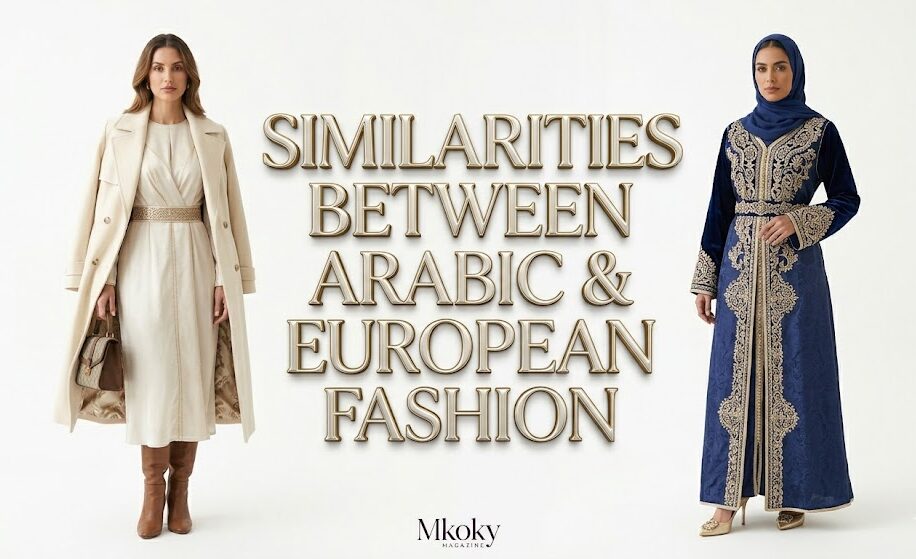
Discover the fascinating European and Arabic Womens Fashion Similarities. Explore how modesty, luxury fabrics, and global trends are creating a beautiful cultural fusion in modern women’s style.
The Elegance of Intersection: Exploring Similarities Between European and Arabic Womens Fashion
In the contemporary world, fashion is no longer confined by geographical borders or rigid cultural silos. It has become a universal language—a silent dialogue between East and West. At Mkoky Magazine, we observe a fascinating evolution: the gap between European “Chic” and Arabic “Elegance” is narrowing. From the runways of Paris and Milan to the bustling fashion hubs of Dubai and Cairo, women worldwide are embracing a shared aesthetic that celebrates femininity, power, and grace.
If you have ever felt that a Parisian maxi dress reminds you of a modern Abaya, or that an Italian lace blouse mirrors the intricate embroidery of a Levantine Thobe, you are witnessing the Cultural Fusion of the 21st century. In this guide, we dive deep into the profound similarities between European and Arabic womens fashion and why this intersection is the future of the global wardrobe.
1. The Global Rise of Modest Fashion
The most significant bridge between European and Arabic fashion today is the Modest Fashion Movement. For decades, Arabic fashion was synonymous with modesty (Haya), characterized by loose silhouettes, long sleeves, and high necklines. Interestingly, in the last five years, major European fashion houses—such as Dior, Chanel, and Gucci—have pivoted toward these exact silhouettes.
The Maxi Silhouette
The “Maxi” dress is a staple in every European woman’s summer wardrobe. Its flowing nature and full-length coverage are direct parallels to the traditional Arabic Abaya or Kaftan. Women in London and Paris now seek the same “effortless flow” that Arabic women have perfected for centuries. This shared preference for long, sweeping garments isn’t just about culture; it’s about the Performance of the garment—providing comfort without sacrificing style.
2. A Shared Love for Luxury Fabrics and Textures
Both European and Arabic fashion cultures place a massive premium on the quality of textiles. There is a mutual respect for fabrics that “speak” of luxury and heritage.
Intricate Lace and Embroidery
European fashion, particularly French and Italian, has a storied history of Dentelle (lace). Similarly, Arabic fashion is famous for its hand-stitched embroidery and gold-thread work (Zari). Today, you will see a Lebanese designer like Elie Saab or Zuhair Murad—who cater to both markets—seamlessly blending these styles. Whether it is a gown for a wedding in Rome or a Gala in Riyadh, the use of intricate lace is a shared signature of high-status femininity.
Silk and Linen
In the heat of the Mediterranean or the Arabian Peninsula, silk and linen are the preferred choices. European “Coastal Chic” relies heavily on high-quality linen trousers and shirts, mirroring the breathable, light-colored fabrics favored in Arabic summer collections.
3. The “Power Suit” Evolution
As women worldwide take on more leadership roles in business and entrepreneurship, the Power Suit has become a global uniform. Here, the similarities are striking.
Arabic women have reimagined the traditional “Set” into sophisticated, loose-fitting blazers and wide-leg trousers that respect cultural modesty while projecting authority. Simultaneously, European designers have moved away from hyper-fitted suits to “Oversized” and “Relaxed” tailoring. This convergence means that a professional woman in Berlin and a digital entrepreneur in Egypt (much like our founder, Mohamed Gad) can wear essentially the same “Structured Minimalist” look and feel equally represented.
4. Accessories: The Language of Detail
In both cultures, a look is never complete without the right accessories. European and Arabic womens share a deep appreciation for “Statement” pieces.
-
The Silk Scarf: In Europe, the silk scarf is an icon of luxury (think Hermès). In the Arabic world, the scarf is often a central element of the outfit (Hijab or Shayla). Both cultures use the scarf to add color, texture, and a sense of “Finish” to the overall look.
-
Gold Jewelry: While European “Minimalism” is popular, “Statement Gold” is a shared passion. Chunky gold earrings or layered necklaces are as common on the streets of Milan as they are in the boutiques of Beirut.
5. The “Red Carpet” Synergy: Haute Couture
The world of Haute Couture is perhaps where the similarities are most visible. If you look at the archives of Valentino or Balenciaga, you will see gowns that are celebrated for their volume, draping, and drama—elements that are deeply rooted in the Arabic aesthetic of “Majesty.”
Many Arabic designers have become the “Kings of Paris Fashion Week,” proving that the Arabic eye for glamour and the European eye for structure are two sides of the same coin. This synergy creates a “Global Gala” style where it is often impossible to tell if a gown was designed in an atelier in France or a studio in Lebanon.
6. The Impact of Digital Influence
Why are these styles merging so quickly? The answer lies in digital platforms like Instagram and TikTok.
Fashion influencers from the Middle East are now some of the most-followed icons in Europe, and vice versa. An “OOTD” (Outfit of the Day) posted by a woman in New York can instantly inspire a woman in Cairo. At Mkoky Mag, we see this trend daily. Our readers are “Global Citizens” who might pair a Zara blazer with a locally designed Kaftan. This “Mix and Match” approach is the ultimate proof that fashion similarities are driven by a shared digital culture.
Why This Fusion Matters for You
For you, the modern woman, these similarities offer Freedom. You are no longer restricted to one “Look.”
-
Versatility: You can invest in pieces that work globally. A well-tailored maxi skirt is as appropriate for a meeting in London as it is for a dinner in Doha.
-
Sustainability: By focusing on shared elements like high-quality fabrics and timeless silhouettes, you build a “Capsule Wardrobe” that transcends seasonal trends.
-
Cultural Confidence: Embracing the similarities allows you to celebrate your heritage while feeling connected to the global fashion pulse.
FAQs: Navigating Global Fashion Trends
1. Can I wear Arabic-inspired clothing if I am not from the region?
Absolutely. Fashion is a form of cultural appreciation. Items like Kaftans and Kimonos have become global staples. The key is to wear them with respect for their craftsmanship and history.
2. How do I make European “Chic” look more modest?
The “Layering” technique is your best friend. A European slip dress can be paired with a structured blazer or a sheer long-sleeved undershirt to achieve an Arabic-inspired modest look.
3. What is the most common shared accessory?
The Designer Handbag. Regardless of culture, a high-quality leather handbag is the universal symbol of a polished, professional woman.
4. Are Arabic designers popular in Europe?
Yes, designers like Elie Saab, Reem Acra, and Rabih Kayrouz are among the most respected names in the European fashion industry, often leading the trends in evening wear.
Conclusion: Fashion as a Bridge
The similarities between European and Arabic womens fashion remind us that we have more in common than we have differences. We all seek beauty, we all value quality, and we all use clothing to express our identity and strength.
At Mkoky Magazine, we celebrate this Global Woman. Whether you are navigating the streets of a European capital or the avenues of an Arabic metropolis, your style is a bridge between worlds. Embrace the fusion, experiment with the textures, and remember that true elegance knows no borders.
-
European and Arabic Womens Fashion Fusion
-
European and Arabic Womens Style Similarities
-
European and Arabic Womens Modest Trends
-
European and Arabic Womens Contemporary Elegance
-
European and Arabic Womens Global Wardrobe
Leave a Reply